
Customer story
Assisted selling with RFID: how Lacoste cut customer wait times
A customer asks for a size. If nobody knows whether it's on another floor or in one of nine back stocks, they wait. At Lacoste's Paris flagship, associates now know before they go.
The result
Customer waiting time, down from 7 minutes
up from 14%
The challenge: every search cost time
Lacoste sells premium products with few units per size. When a size isn't on the floor, an associate has to find it across three sales floors and nine themed back stocks, while the customer waits.
In assisted selling, that wait is the whole experience. The associate is with the customer, so every minute spent searching is a minute the customer stands alone.
“With few products, quality and high value with low stock depth in store stocks we needed a new inventory model with surgical precision. When every product and every customer matter we cannot afford the imperfections of the mass-market retail model.”Sébastien Fayet, CEO, Lacoste France
The setup: accuracy first, then search
Lacoste configured Retail Reload for counting and discrepancy management "for optimal accuracy". Only then did it add the sales app, in the version for stores with back-stock associates.
The order matters. A search tool is only as good as the stock behind it: if the record is wrong, associates walk to a back stock for an item that isn't there.
The result: shorter waits, more sales
Customer waiting time fell from 7 minutes to 2.51 minutes. Store conversion rose from 14% to 18%, a gain of four percentage points.
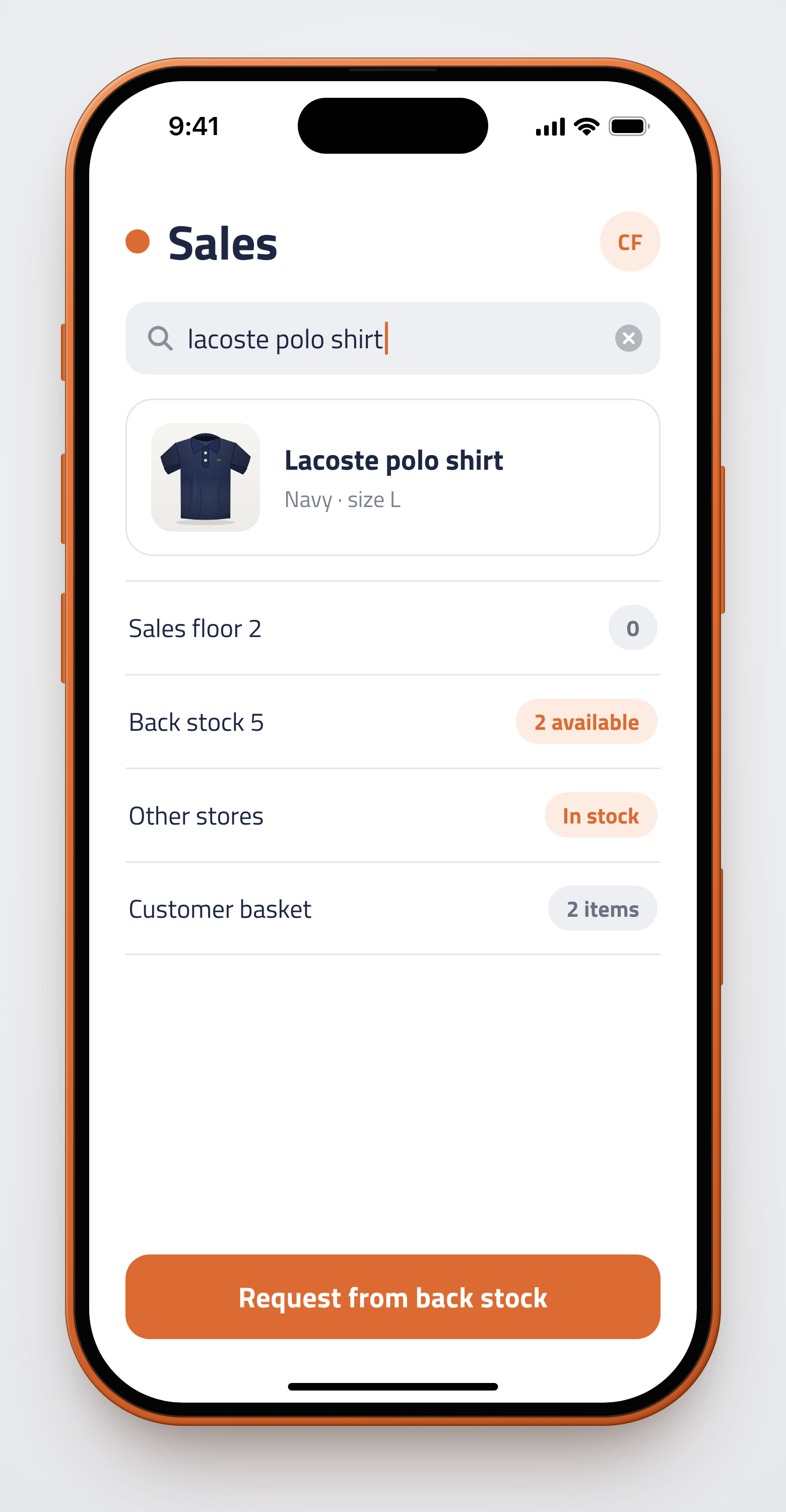
The sales app
What associates have in their hand
Is the size available, and where is it?
The customer's selection is built in the app.
Requests go straight to the back-stock team.
Out of stock here? See where else it is.
With or without back-stock associates.
Follow up on items asked for but not bought.
Takeaways
What other fashion retailers can use
- Fix accuracy before search. Lacoste started with counting and discrepancy management. Search is only as good as the stock behind it.
- Measure waiting time. It's the lever; conversion follows. Record a baseline before the pilot.
- Match the app to the store. A flagship with a back-stock team works differently from a store where associates fetch items themselves.
- Keep the lost requests. Sizes customers asked for but couldn't get show demand that sales data never records.
FAQ
Questions about this project
What results did Lacoste see with RFID?
At the Champs-Élysées flagship, customer waiting time fell from 7 to 2.51 minutes and store conversion rose from 14% to 18%.
What is assisted selling?
A store model where associates serve customers directly, including fetching sizes and colours from the stockroom. It's common in premium fashion.
How does RFID cut customer waiting time?
Associates see whether an item is available and where it is before they go to look, so they stop searching for items that aren't there.
Does the sales app work without back-stock staff?
Yes. Retail Reload's sales application has two operating modes: with or without back-stock associates.
How long do your customers wait?
Share your setup. The team follows up with a project costing and a personalised ROI simulation.
Related guides: RFID stocktaking · RFID software for fashion retailers · Click-and-collect and ship-from-store
About Retail Reload. Retail Reload is an RFID platform for fashion retailers. It tracks each item's status and location in the store, supports fast stocktaking and replenishment, and powers click-and-collect and ship-from-store. It works with existing RFID hardware and connects to OMS, ERP, WMS and BI systems.